Apartment Soundproofing on a Budget (Renter-Friendly)
Practical, reversible soundproofing solutions for renters. Reduce noise from neighbors without modifying your apartment or losing your deposit.
From the team behind the QuietScore iOS app
You can hear your neighbor’s TV. Their conversations. Their dog. Maybe their footsteps from above. And you’re renting — so you can’t rip out walls or install resilient channels.
This guide covers what actually works for renters, what doesn’t, and how to spend your money wisely. Everything here is reversible — no damage, no lost deposits.
First: Understand What You’re Dealing With
Before buying anything, figure out where the sound is coming from and what type of sound it is. This determines which fixes will actually help.
Where is it loudest?
Walk around the room and listen. Put your ear near:
- The wall shared with your neighbor
- The door
- The window
- Vents and ducts
- Electrical outlets on the shared wall
The loudest spot is your primary leak. Often it’s the door or window — not the wall itself.
Quick test: Use QuietScore to measure each barrier separately. You might discover your wall is STC 35 (decent) while your door is STC 22 (terrible). That means the door is your problem, not the wall.
What kind of sound?
| Sound type | Examples | What works |
|---|---|---|
| Airborne (speech, TV, music) | Conversations, television, stereo | Seal gaps, add mass, heavy curtains |
| Impact (footsteps, banging) | Footsteps from above, doors slamming, dropped objects | Rugs with pad, furniture isolation pads, ceiling solutions |
| Low-frequency (bass) | Subwoofer, bass guitar, club music | Very hard to block without construction. Mass + decoupling needed. |
Honest truth about bass: If your neighbor has a subwoofer, no renter-friendly solution will fully solve the problem. Low-frequency sound requires serious mass and structural decoupling. You can reduce it, but you likely can’t eliminate it without construction work. In this case, a conversation with your neighbor or landlord is your best first step.
What Actually Works (Ranked by Effectiveness)
1. Seal door gaps ($10–$30)
Effectiveness: High — Often the single biggest improvement for the least money.
Most apartment doors have gaps that let sound pour through. Even “decent” walls are undermined by a poorly sealed door.
- Adhesive weatherstripping ($5–$10) around the door frame — removable when you move out
- Door sweep ($10–$15) — screw-on types leave small holes (fill with putty when you leave) or use adhesive-backed sweeps
- Draft stopper (free–$10) — a fabric tube at the base of the door. Not as effective as a sweep but zero damage
See our complete door soundproofing guide for detailed instructions.
2. Window sealing ($10–$100)
Effectiveness: Medium to High — Depends on window quality.
Single-pane windows (common in older apartments) are STC 26–28. If the window faces a busy street, it may be your main noise source.
- Window seal tape ($8–$15) — Seal gaps around the window frame
- Acoustic window inserts ($100–$200/window) — Clear acrylic panels that mount inside the window frame with compression seals. Create a 50–100mm air gap. Removable. STC improvement of 5–10 points.
- Heavy curtains ($30–$80) — Marginally reduce high-frequency sound. Better for echo reduction than transmission. Don’t expect miracles, but they help a little and are easy to install.
- DIY window plug ($20–$40) — An MDF or foam board panel cut to press-fit into the window opening. Block the window completely for maximum effect. Good for bedrooms at night.
3. Rugs and carpet padding ($50–$300)
Effectiveness: Medium — Specifically for impact noise from above or below.
If footsteps are your problem (you hear them from above, or your downstairs neighbor hears yours), floor treatment helps.
- Thick area rug with a dense rubber pad underneath — The pad matters more than the rug. Look for 10mm+ rubber or felt padding, not cheap foam.
- Cover as much of the hard floor as possible — especially in hallways and living areas where people walk most
- Interlocking rubber gym mats ($30–$50 for a room) — Not pretty, but very effective under area rugs or in utility areas
For your own footstep noise: Rugs + padding on your floor will reduce what your downstairs neighbor hears. This is often the neighborly solution and may resolve complaints.
4. Rearrange and add mass (free–$100)
Strategic furniture placement costs nothing and can make a real difference.
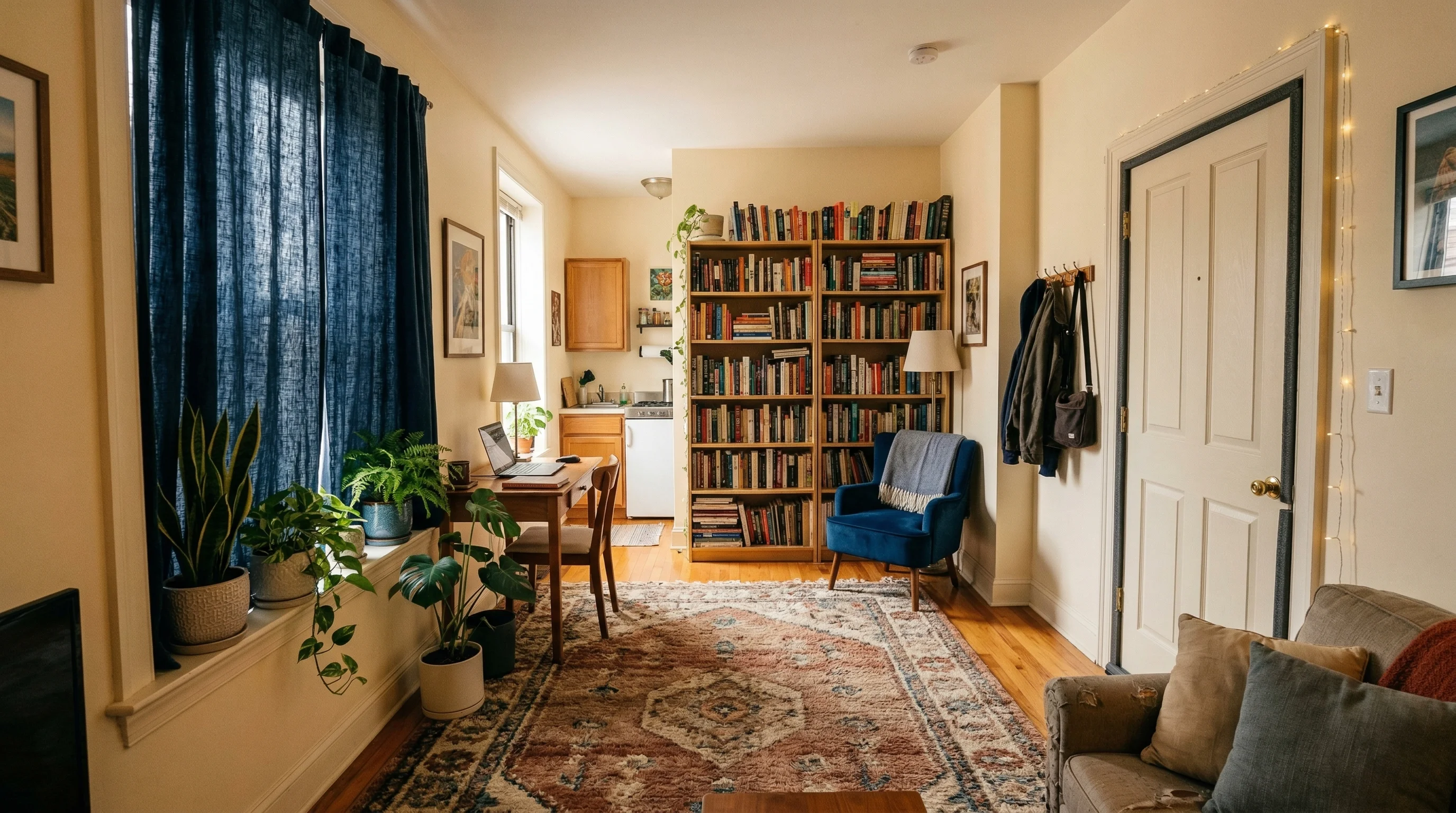
- Bookshelf against the shared wall — A fully loaded bookshelf adds significant mass. Place it directly against the wall where you hear the most noise.
- Move your bed or desk away from the shared wall — Increasing distance from the noise source reduces perceived volume
- Heavy furniture against noisy walls — Dressers, wardrobes, and cabinets all add mass
Does it actually work? A loaded bookshelf against a wall won’t transform the room. But it can provide 2–3 dB reduction at the frequencies where the books add mass. Combined with other fixes, it contributes.
5. Outlet and switch gaskets ($5)
Effectiveness: Low to Medium — Depends on your building.
In many apartments, electrical outlets on shared walls are back-to-back — creating a direct sound path through the wall.
- Foam outlet gaskets ($5 for a pack) — Sit behind the outlet cover. Takes 2 minutes to install, completely reversible.
- Check if you can feel air movement around outlets on shared walls — if so, this fix will help
6. White noise or sound masking ($15–$50)
Not soundproofing, but effective for sleep and focus.
- White noise machine ($20–$40) — Raises your room’s ambient noise floor, masking lower-level sounds from neighbors
- Fan — Free if you already have one
- Pink noise — More balanced than white noise, easier on the ears for sleep. Available as apps or dedicated machines.
This doesn’t reduce the noise, but it reduces your perception of the noise. For mild problems, it may be all you need.
What Doesn’t Work (Don’t Waste Your Money)
Acoustic foam panels
Those egg-crate or pyramid foam panels you see on YouTube and Amazon? They absorb echo inside a room. They do almost nothing to block sound between rooms.
STC improvement from foam on a wall: 0–1 points. Save your money.
Thin mass-loaded vinyl on walls (without sealing)
MLV can work, but only if installed correctly with every edge sealed. Just taping or hanging MLV sheets on a wall without sealing gaps is marginally effective. And in a rental, proper MLV installation (adhesive + screws) may not be feasible.
”Soundproof” paint
Multiple companies sell paint marketed as soundproofing. Independent testing shows it adds less than 1 STC point. The product exists; the performance doesn’t.
Moving blankets hung on walls
Like acoustic foam — they reduce echo inside the room but barely affect transmission through the wall. Unless you can hang 4–5 layers (at which point the weight will pull down any temporary hanging method), this is not a sound transmission solution.
The Renter’s Soundproofing Checklist
In order of priority — do the cheap, effective stuff first:
- Identify the leak — Test with QuietScore or just listen carefully at each surface
- Seal door gaps — Weatherstripping + door sweep ($15)
- Seal window gaps — Window tape ($10)
- Outlet gaskets on shared walls ($5)
- Rugs with dense padding if floor/ceiling noise is an issue ($50–$200)
- Bookshelf or heavy furniture against shared wall (free if you already have it)
- Window insert if windows are the main problem ($100–$200)
- White noise machine for remaining background noise ($25)
Total budget for meaningful improvement: $30–$200
When to Talk to Your Landlord
Some fixes require landlord involvement:
- Requesting a solid-core door — Many landlords will upgrade if you explain the issue. It’s a permanent improvement to their property.
- Requesting window upgrades — Older single-pane windows may qualify for energy efficiency upgrades that also improve sound
- Duct sealing — If sound travels between apartments through ductwork, the landlord needs to address this
Frame it as a property improvement, not just your complaint. “This upgrade would increase the apartment’s value and reduce tenant turnover” works better than “your building is noisy.”
Before You Sign a Lease
If you’re apartment hunting and noise is a concern, test before you commit:
- Visit at different times — evenings and weekends show real noise levels
- Stand quietly in each room and listen
- Check the doors — hollow-core or solid?
- Check the windows — single or double pane?
- Ask about the neighbors — top floor has no upstairs footsteps, end units have one fewer shared wall
- Bring a Bluetooth or AirPlay speaker and run a quick QuietScore test on shared walls
Building types ranked by sound isolation (generally):
- Concrete buildings — Best. Dense concrete blocks sound effectively.
- Brick buildings — Good. Older brick buildings usually have solid walls.
- Wood-frame with double drywall — Decent. Common in newer construction with fire rating requirements.
- Wood-frame with single drywall — Poor. Standard in budget apartment construction. This is where most noise complaints live.
Next Steps
- How to Soundproof a Door — Detailed door guide
- How to Improve Your Soundproofing — All solutions for all budgets
- STC Rating Explained — Understand what the numbers mean
- How to Test Soundproofing at Home — Measure before you spend